
Swimming the Tiber
Cor ad cor loquitur ('Heart speaks unto heart') - John Henry Newman’s motto

[If the reader has not done so, we would encourage you to read last week's posting on The Oxford Movement for appropriate background information.]
To understand the historical basis for the Oxford Movement controversy we describe, one must consider the observation attributed to Queen Elizabeth I in her Religious Settlement of 1559.
[Wait, bear with me. This isn’t a dry history lecture. There will be no dates on the quiz.]
In the documents that were signed by her, Anglicanism is identified as the via media, or “middle way”, between Catholicism and Protestantism.
The Settlement permits The Church to retain Catholic elements such as clergy hierarchy and sacramental theology [but without the need for papal authority], joined with a Protestant emphasis on justification by faith.
Thus was formed the distinct identity of The Church of England and its Anglican progeny, including The Episcopal Church of the United States.
Obviously, this would create an inevitable tension in Anglicanism as to how Catholic or how Protestant individual Anglicans, their dioceses and parishes, would be and which formula for worship and belief was superior.
The Oxford Movement was the classic example of that tension in action.
If you are or were a Roman Catholic and attended a secular college or university, then you may have had a Newman Center on your campus1. There you would find a place for spiritual support, a regular celebration of the Mass, booths for confession, and organized social events designed to boost a Catholic sense of community.
They are named for Cardinal John Henry Newman [1801-1890] and are based on his voluminous writings that explore and promote a Catholic world view. It was Newman who originally proposed to the Church of Rome the need for places of Catholic spirituality on secular campuses.
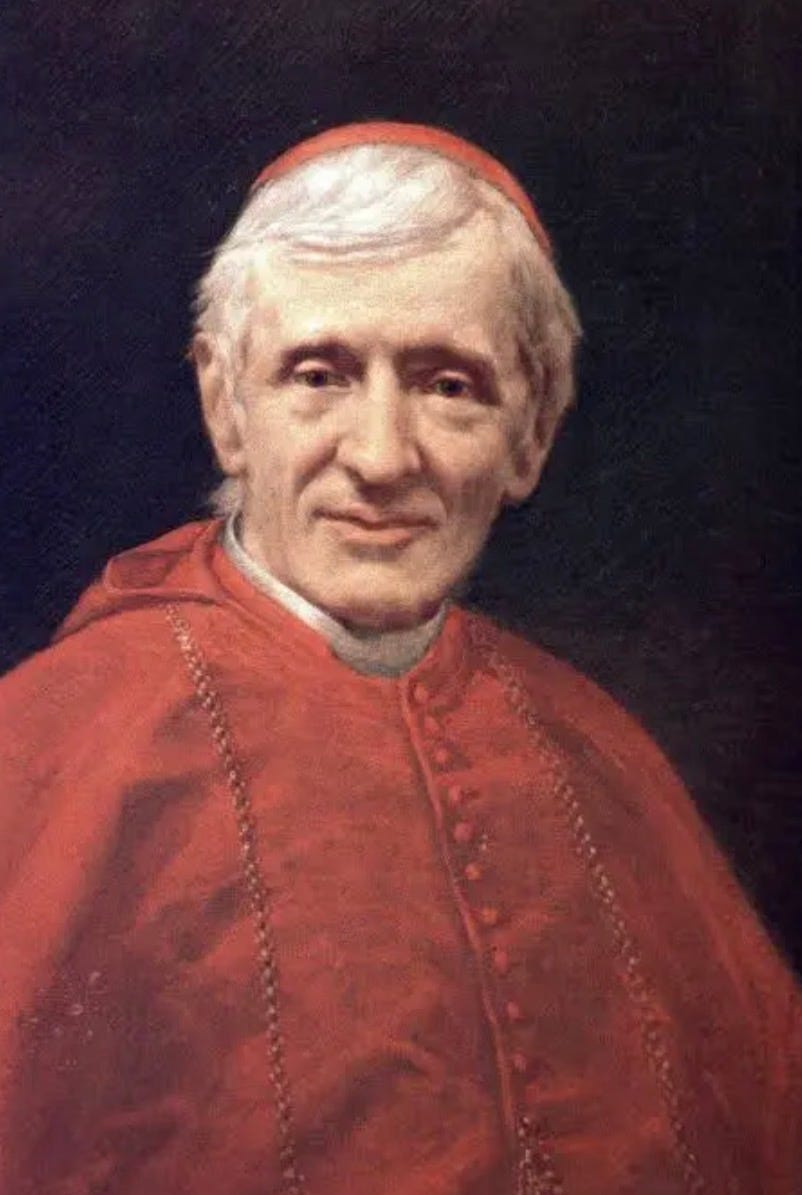
What the reader may not have known is that, in 1833, when John Keble was preaching his prophetic sermon of which we spoke the other day, Newman was a colleague of Keble’s at Oxford and a fellow Anglican priest.2 He was also Keble’s friend.
As with Keble, Newman was a contributor to Tracts for the Times, that series of pamphlets written by Oxford clergy who argued for the restoration of the Catholic elements of Anglican worship that been lost for a couple of centuries.
However, while Keble made his case for restoration without personally suffering repercussions or any scabrous controversy with The Church of England’s hierarchy, Newman was of a more confrontational personality.
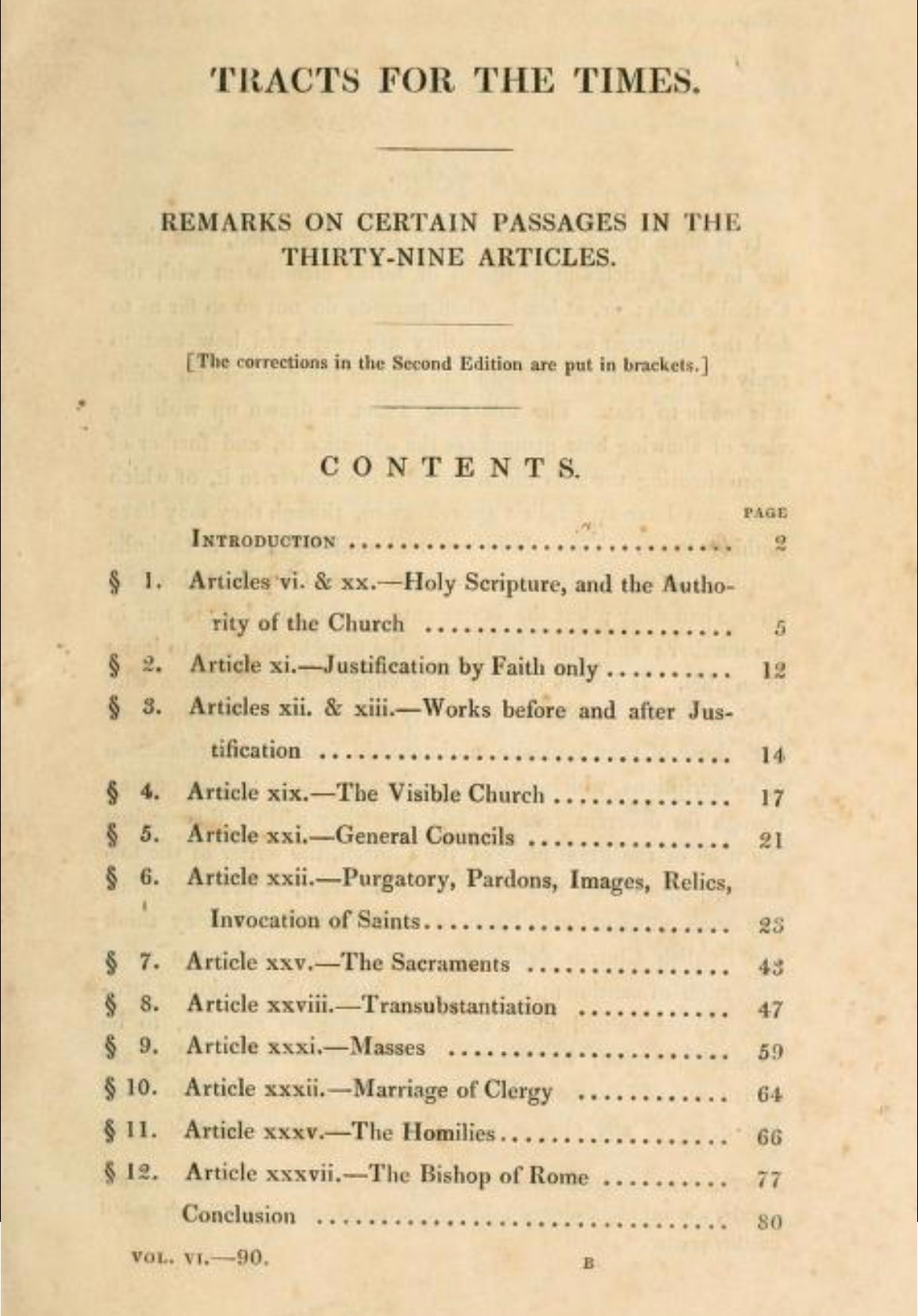
Nowhere is this more obvious than in Tract 90, the final addition to Tracts for the Times wherein Newman disputes the foundational articles of Anglicanism3, likening The Church of England to one of the earlier heretical groups in Christian history.
This made him increasingly unlikely to be invited to share a pre-Evensong sherry with the bishop. In fact, the Bishop of Oxford ordered Tracts for the Times immediately to cease publication forever. Newman found himself becoming persona non grata in The Church of England.
He marked this increasing separation by leaving Oxford University and forming a sort of free-range “monastic” experience on the outskirts of that university town.4
Despite some pungent criticism of The Church of Rome that Newman had issued during previous years, these opinions he recanted and eventually made an historic choice.
With an appeal sent to the papal offices, Newman petitioned to be received into The Church of Rome as a communicant. Furthermore, he desired to study for ordination as a Roman Catholic priest.
This was acceptable to papal authority and Newman was ordained a Roman Catholic priest in 1846, and eventually elevated to the College of Cardinals in 1879.5
It is an understatement to note he found a warmer, more receptive community in The Church of Rome. Newman would even be canonized as a saint in 2019, and he was named the most recent Doctor of the Church just last November.
Thus it was said that Newman had “swum the Tiber”, the term that now connotes any Anglican/Episcopal priest or lay person who surrenders the Anglican tradition for that of Rome.6
Much to the surprise of The Church of England, happy as they were for Newman to be ensconced in his parish7 and dusty study at an Oxfordian college8, his clean understanding of traditional theology, rendered in a lyrical, rather than academic style, was that on which The Church of Rome would build fresh ministries and encourage inspired participation.
As an Anglican priest, Newman was well-known and popular. As a Roman Catholic priest, he became famous and celebrated. He spent most of his final forty years in Birmingham, establishing oratories and centers of Catholic learning throughout Britain and Ireland and continuing to write theology, sermons, lecture, scriptural reflections, and poetry.
While he is not included on the feast days on the Anglican calendar, nor considered a Teacher of the Faith, those who follow the Anglo-Catholic tradition in The Episcopal Church often make use of Newman’s works and theological perspective. He has also, by extension, encouraged others to swim the Tiber to what they seem to find a more fulfilling tradition.
Offhand and without research, I can name the following Tiber swimmers:
Gerard Manley Hopkins, the prominent English poet of the late 19th/early 20th century.
Evelyn Waugh, 20th century English novelist, perhaps best-known for Brideshead Revisited.
Thomas Merton, of whom we have spoken in these pages, one of the most quoted and read mystics and theologians of the 20th century.
Dorothy Day, a renowned free-thinker who, at her moment of revelation, found it not in The Episcopal Church in which she was baptized, but upon her conversion to Roman Catholicism. She then founded The Catholic Worker Movement.
Jeffrey Steenson, a bishop and leading intellect in the 20th/21st century Episcopal Church, who became a Roman Catholic priest/educator and Vatican official.
Richard John Neuhaus, founder of First Things, a magazine of Christian commentary and thought. [He actually went from Lutheran pastor to Episcopal priest to Roman Catholic priest. That’s a lot of liturgy to learn.]
A.N. Wilson, an author of popular histories, including a well-received biography of St. Paul.
That is considerable creativity, achievement, and just plain brain-power that was and is an unfortunate loss to the Anglican tradition. If I may be provocative, sometimes innovation and asymmetrical thinking are not prized in the greater church that I serve.
Having said that, I acknowledge that many of my best parishioners over the decades have been those who “swam the Thames.” Perhaps it all evens out.
Newman would cease to be mortal in his 89th year with his final Mass celebrated on Christmas Day of 1889. He would be buried on the grounds of the Birmingham Oratory that he had founded.
[A weird side note: In 2008, it was decided to move Newman’s remains to a more secure location at the Oratory in order to facilitate veneration and protection of his relics. Upon exhumation, while the remaining bits of his coffin were found, his remains were not. A forensic analyst was hired and could provide no explanation other than that the body had never been there. In my imagination I hear Robert Ripley saying, “Believe it or not.”]
St. John Henry Newman’s feast day in The Church of Rome is October 9th, the anniversary of his conversion. Despite his estrangement from Anglicanism, Newman’s efforts, along with those of his friend John Keble and the other Tractarians, did result in the restoration of Catholic elements to the via media.
To gain appreciation for Newman’s relationship with Christ, instead of a collect, I offer the words he wrote for the familiar hymn, “Lead, Kindly Light”:
Lead, kindly Light, amid th’ encircling gloom,
Lead Thou me on;
The night is dark, and I am far from home,
Lead Thou me on;

Keep Thou my feet; I do not ask to see
The distant scene; one step enough for me.
I was not ever thus, nor prayed that Thou
Shouldst lead me on;
I loved to choose and see my path, but now
Lead Thou me on;

I loved the garish day, and spite of fears,
Pride ruled my will; remember not past years.
So long Thy pow’r has blest me, sure it still
Wilt lead me on,

O’er moor and fen, o’er crag and torrent, till
The night is gone,
And with the morn those angel faces smile,
Which I have loved long since, and lost awhile.
The most active local chapter may be found at Western Connecticut State University.
Keble was a professor of poetry; Newman of Hebrew. Newman was ordained an Anglican priest in 1825.
The 39 Articles of Religion, which form the framework of Anglicanism, may be found in The Episcopal Church’s Book of Common Prayer [the current edition] beginning on page 867.
We note that Roman Catholics were not permitted employment at Oxford University in Newman’s day. As he was moving in the direction of Rome, I’m sure he recognized the inevitable.
Newman was a “cardinal-deacon”; a status granted to those not first a bishop, often a prominent cleric upon retirement or in achieving his 80th birthday. Or if one is pals with the pope. Cardinal-Deacons do not vote in conclave, but have traditionally been addressed as “Your Eminence” and wear the red vestments.
The opposite action from Rome to England is known as “Swimming the Thames.”
Newman was vicar of St. Mary’s, Oxford, home of the pulpit from which John Keble preached his famous sermon.
Oriel College, where he was tutor and Fellow.
Thank you for this enlightening post. I always wondered why it was called "The Newman Center". Not that I ever visited it in college. I, and many I know, have swum the Thames, but I don't personally know anyone who has swum the Tiber.