
The Vicar’s Daughter
“The people who hanged Christ never, to do them justice, accused him of being a bore—anybody who has ever been to church knows that the real trouble with Christianity is that it is a bore.”

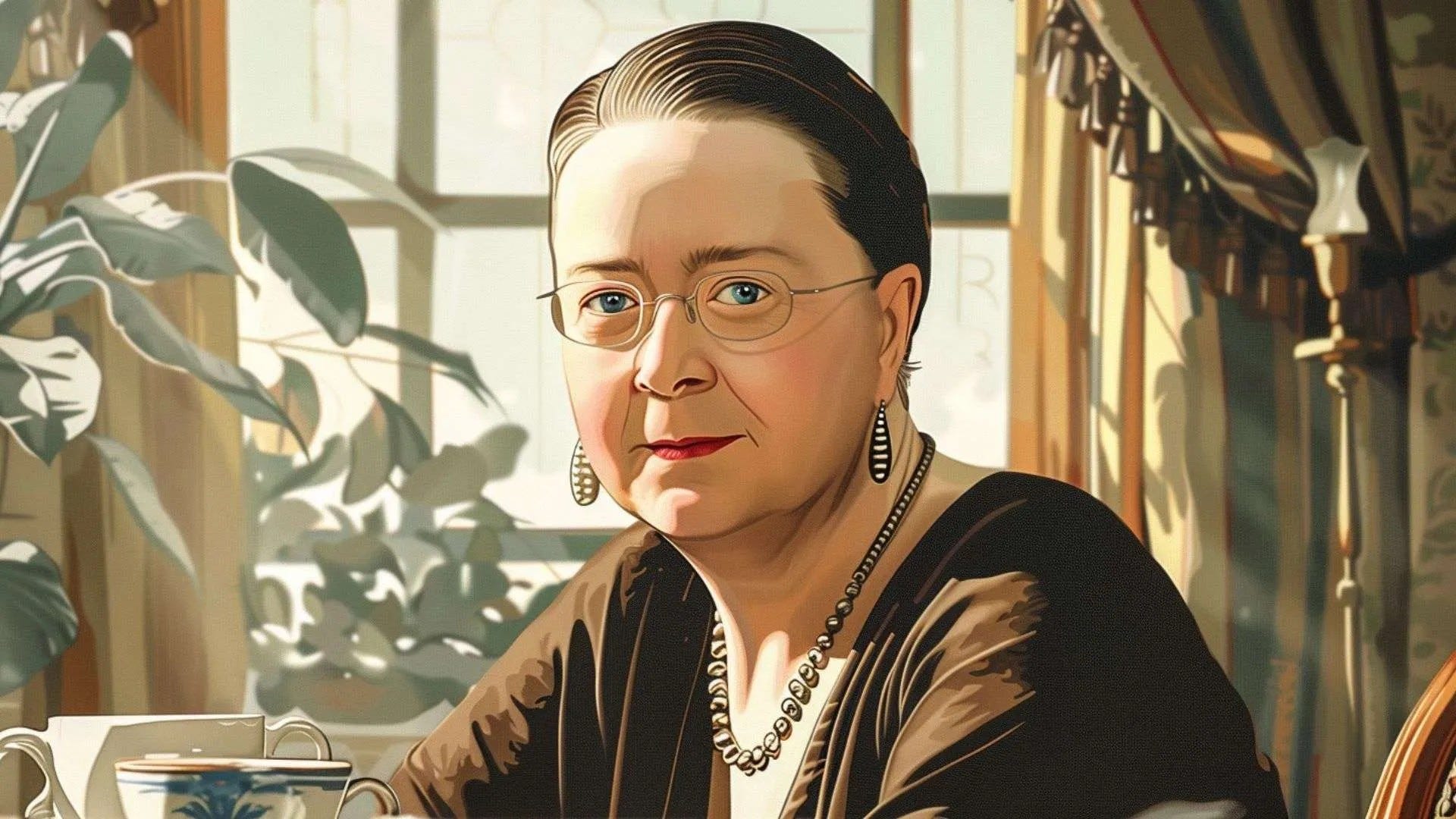
That was how she was identified in her Oxford childhood, by her father’s job rather than by her name. Dorothy Leigh Sayers [1893–1957] would become very much more than the vicar’s daughter during the course of her life, however.
It is perhaps thanks to PBS’ Masterpiece Mystery and related programming that we still have familiarity with Sayers at all, as they have twice produced dramas based on her mystery books. Featuring the aristocratic Lord Peter Wimsey, amateur detective, and his highly independent eventual wife, the artist Harriet Vane, the stories were so popular that Sayers is still recognized as one of literature’s four “Queens of Crime”1
While she was a novelist, playwright, scholar, and translator, our interest is in her work as a lay theologian, where she brought to a moribund field her intellect, wit, and imagination as a champion of historic Christianity.
“It is worse than useless for Christians to talk about the importance of Christian morality, unless they are prepared to take their stand upon the fundamentals of Christian theology.” - from Creed or Chaos? (1940)
Unlike contemporaries who relied primarily on a philosophical prism, [her friend C.S. Lewis comes to mind], Sayers emphasized the dramatic and creative dimensions of the faith. She argued that Christianity is not rote moralism nor nebulous spirituality, but the most inspiring and coherent story ever told, one that encourages intellectual honesty and artistic excellence.
“It is the neglect of dogma that makes for dullness. The Christian faith is the most exciting drama that ever staggered the imagination of man—and the dogma is the drama.” - from The Greatest Drama Ever Staged [1938]
Her work as an apologist emerged not from formal theological training2 but from a deep engagement with doctrine, literature, and culture, making her contributions accessible and profound.
Born in Oxford, as her father was an Anglican priest who served as chaplain for the college of Christ Church, the language and rituals of the Church of England were her medium. She excelled academically, receiving an Oxford degree in 1915.3
Early in her career, she wrote poetry, coined slogans for an advertising agency, and then achieved her fame with detective fiction. Her faith deepened through reading G.K. Chesterton, another mystery writer/lay theologian.4 By the 1930’s and ‘40’s, amid the crises of war and secularism, she turned increasingly to religious themes. While she never sought a theological role, her eloquence thrust her into it.
“For whatever reason God chose to make man as he is—limited and suffering and subject to sorrows and death—He had the honesty and the courage to take His own medicine.” - from Letters to a Diminished Church [collection published in 2004]
Sayers breakthrough came through drama. Invited to write a play for the Canterbury Festival in 1937, she produced The Zeal of Thy House, exploring craftsmanship, pride, and divine calling through a 12th-century architect. Its success led to more commissions. In response to questions about her own faith, she penned the provocative 1938 essay, “The Greatest Drama Ever Staged,” published in the Sunday Times. In it, she lambasted the domestication of Christianity. [The quotation in the sub-heading is from this work.]
She presented the Gospel not as dry propositions but as high drama: God enters history, confronts Evil, and rises victorious. This essay, along with “The Dogma is the Drama” and “Creed or Chaos?,” became foundational. She insisted that doctrine matters because it shapes reality. Without robust faith, society descends into chaos.
[Yeah, we’ve noticed.]
Her radio drama, The Man Born to Be King [1941–42], exemplified this dramatic approach. Broadcast by the BBC, it portrayed Jesus and his contemporaries in vivid, contemporary English rather than through archaic stylized language. Critics initially protested the irreverence of having Jesus speak like an ordinary person, but audiences were gripped. The series reached millions, humanizing the Gospel and recognizing its power.
“I believe it to be a grave mistake to present Christianity as something charming and popular with no offense in it.” - from Letters to a Diminished Church
Sayers treated the Biblical narrative as history’s central drama, not sanitized piety but a story of conflict, sacrifice, and redemption that demands response. This imaginative apologetics prefigured Lewis’s own BBC broadcasts and demonstrated her belief that proper art of any sort could convey truth more effectively than abstract argument.
Central to Sayers’ apologetic legacy is The Mind of the Maker (1941), her most sustained theological work. Drawing on her experience as a creative writer, she analogized the Holy Trinity to the human act of creation. Any creative work, she argued, involves three elements: the Idea [Father], the Energy or Activity [Son], and the Power [Holy Ghost] that communicates it to others.
This is not a simplified illustration but a profound exploration of imago Dei. Humans, made in God’s image, reflect the Trinitarian dynamic in their work. Bad art or shoddy craftsmanship dishonors this image; excellence in any vocation is a form of Christian witness.
“The central dogma of the Incarnation is that by which relevance stands or falls. If Christ were only man, then he is entirely irrelevant to any thought about God; if he is only God, then he is entirely irrelevant to any experience of human life.” - from Creed or Chaos?
Sayers elevated work as a theological category, countering secular materialism and pious obtuseness. The book remains a classic for its integration of aesthetics, Trinitarian doctrine, and practical ethics.
Sayers championed orthodoxy with a delightful pugnacity. In essays collected in volumes like Creed or Chaos?, The Whimsical Christian, and Letters to a Diminished Church, she decried “Christianity-and-water”, a diluted faith stripped of its supernatural claims and doctrinal backbone.
She mocked the tendency to reduce Christ to a “meek and mild” moral teacher, insisting instead on the full Creed of Incarnation, Atonement, and Resurrection.
“It is the neglect of dogma that makes for dullness. The Christian faith is the most exciting drama that ever staggered the imagination of man—and the dogma is the drama.” - from The Greatest Drama Ever Staged [1938]
This emphasis on dogma as vital and interesting directly challenged the liberal theology and cultural Christianity of her day.5 She noted that without objective truth grounded in God, ethics and society fragment. Her wartime writings urged a return to foundational beliefs as the only path to order and meaning.
Sayers’ style distinguished her. It is witty, direct, and allergic to sentimentality. As like G.K. Chesterton, she found humor in paradox. She avoided jargon, drawing on everyday analogies and literary insight. As a layperson and woman in a male-dominated field, she brought fresh perspective, emphasizing imagination alongside reason.6
She collaborated intellectually with figures like Charles Williams and spoke at Lewis’s Socratic Club, bridging literature and theology. Her Dante translations, completed near the end of her life, rendered The Divine Comedy in vigorous, accessible English to make medieval theology live.
Dorothy Sayers’ enduring relevance lies in her diagnosis of a “diminished church” and her remedy, which is to reclaim the full, dramatic, creedal Gospel. In an age of vague spirituality, moral relativism, and cultural fragmentation, her call to robust doctrine, excellent work, and imaginative engagement is still vibrant.
“We have very efficiently pared the claws of the Lion of Judah, certified him ‘meek and mild,’ and recommended him as a fitting household pet for pale curates and pious old ladies.” - from The Greatest Drama Ever Staged
She reminds us that Christianity is not escape but confrontation with reality at its deepest level. It is the story of a Creator who enters creation to redeem it. As both artist and apologist, Sayers showed that defending the faith requires not only clear thinking but joyful, skillful participation in God’s creative work. Her writings continue to challenge believers to think, create, and proclaim with excellence, ensuring the Lion of Judah is never mistaken for a tame housecat.
Yes, she has her own feast day on the Episcopal Church’s calendar, that of December 17th. She even has her own collect:
Almighty God, who strengthened your servant Dorothy Sayers with eloquence to defend Christian teaching: Keep us, we pray, steadfast in your true religion, that in constancy and peace we may always teach right doctrine, and teach doctrine rightly; through Jesus Christ our Lord, who lives and reigns with you and the Holy Spirit, one God, now and for ever. Amen.
An honor she shares with Agatha Christie, Margery Allingham, and Ngaio Marsh.
Having known many “vicar’s daughters”, I would observe they often received a viable theological education just through life in a rectory.
Somerville College, Oxford, Sayer’s alma mater, is a traditional women’s college established in 1879. Although it offered a full, four-year curriculum, the degrees it granted were not formally recognized by Oxford University until 1920. Margaret Thatcher and India Gandhi are also graduates of Somerville.
Creator of amateur detective, Father Brown.
Not just her day. Have you read statements from our House of Bishops over the last fifty years?
Being a lay person and an educated woman, she was liberated from the authority that constrained the male, free-thinking, ordained members of The Church of England in her day. Bishops could not consign her to a minor parish, order her to stop writing, or remove her from liturgical duties. Unlike the clergy, she was beyond malevolent authority. This made her rather beloved by the free-thinking clergy of her time.
Thank you- never heard of her!
Fascinating. If you had to pick one of her theological books as the gateway into her works which would it be?