
An Outlander and Subtle Doctor
John Duns Scotus (c. 1265 -1308)

[While our subject is not considered a Teacher of the Faith in the Anglican/Episcopal tradition, he is a Doctor of the Church (of Rome) and his contributions to the greater development of Christian thought should be acknowledged.]
“God is to be loved for his own sake.”
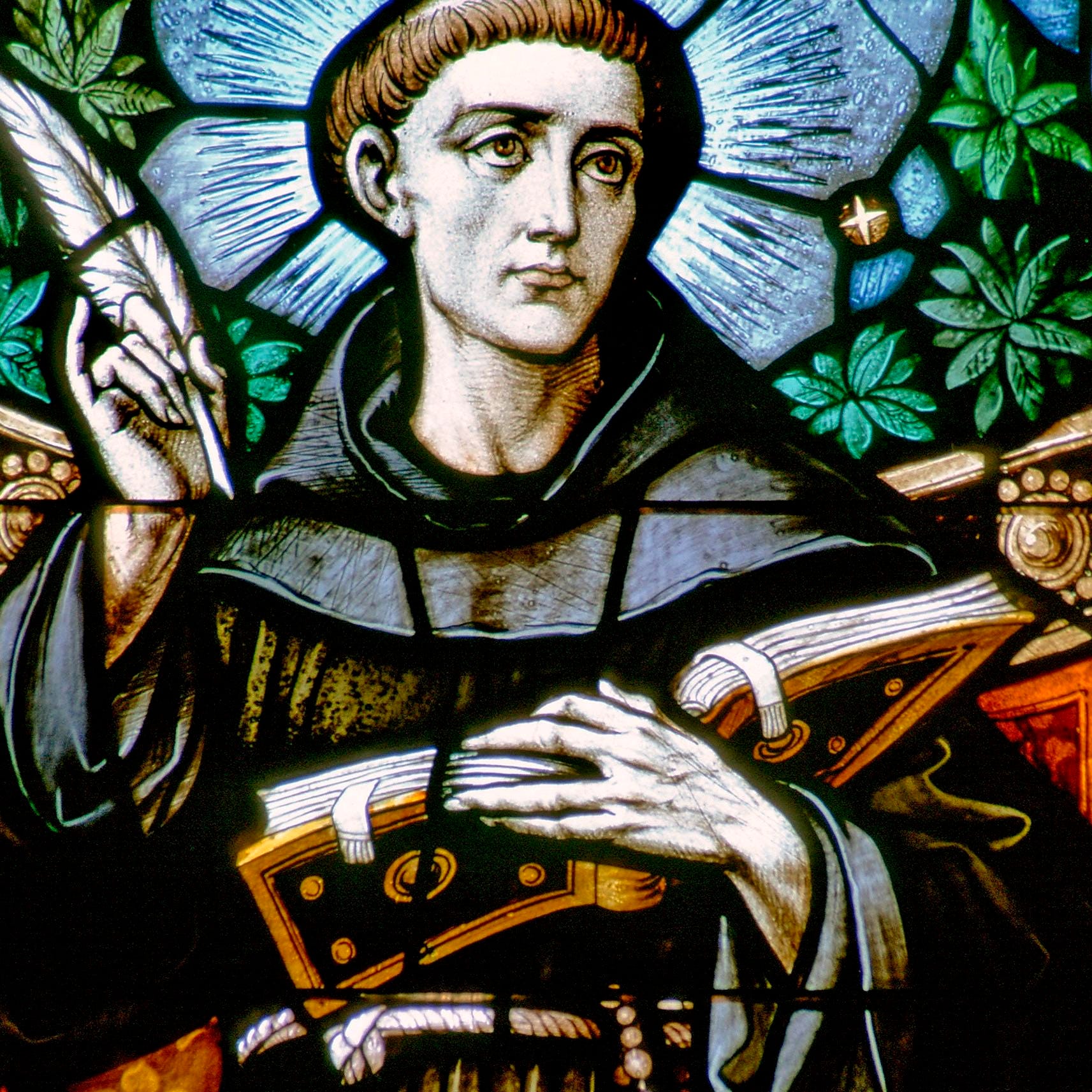
Please understand that these words are written by a man who was utterly baffled his first week in Systematic Theology class at the late, lamented General Theological Seminary in New York City.
The equally late, lamented The Rev. Dr. James Carpenter, one of Paul Tillich’s buddies, was the professor. In his pleasant Carolina cadence he spoke of the Ground of Being, Essence vs. Existence, and Faith vs. Doubt. All this while his retriever, Cinnamon, snoozed in the classroom’s corner.
Cinnamon had it figured out, I always thought.
So, now it’s my turn to speak of these things and baffle the reader. Please alert your family pet.
We have earlier discussed the two leading lights of The University of Paris during the 13th century, when the institution was the center of theological life. Naturally, it was dominated by clerics who were born and raised in the Italian states.1 Others who taught and studied there came from not terribly far away in Paris and its environs.
As the city attracted theologians and their students, who would follow them as young people follow The Grateful Dead or Phish in more recent times, it was inevitable that the University’s luster would spread even to the realms of geographic barbarism. At least one was so exotic as to arrive in Paris from…Scotland.
Despite being an outlander, or perhaps because of it, John Duns Scotus [literally, John from Duns in Scotland] was one the most original and incisive Christian thinkers in an historical period that was filled with such individuals.
Scotus, whose sobriquet is “The Subtle Doctor” (or Doctor Subtilis), earned his nickname for the intricate, nuanced, and highly incisive quality of his philosophical and theological reasoning. A Franciscan friar, he is the fourth great religious thinker of High Scholasticism, joining Thomas Aquinas, Bonaventure, and William of Ockham.2
His school of thought, known as Scotism,3 includes metaphysics, epistemology, ethics, and natural theology, and has left a lasting impression on Western intellectual history, despite his short life.
While his era was dominated by the synthesis of Aristotelian philosophy with Christian orthodoxy made popular by Aquinas, Scotus championed originality rather than homage. He defended positions that challenged the prevailing views while remaining deeply rooted in the Christian faith and Franciscan ecclesiology. Hence, Scotism has an eternal appeal as it has influenced theology, modern philosophy, and even contemporary discussions of individuality.
Duns Scotus was born in Duns in the Scottish Borders, that perpetually disputed area where England and Scotland neighbor one another, often in contention. As has been the case with other leaders of the Medieval Church, little is known about his early life. He joined the Society of St. Francis when he was around fifteen and was found intelligent enough for the Franciscans to send him to Oxford University and subsequently to The University of Paris, which was a Dominican/Franciscan stronghold.4
In 1291, he was ordained a priest and fully professed as a friar. His professional life was chiefly academic. While studying for his terminal degree he served as a lecturer at Oxford [1297-1301] and Paris [1302-1304]. Upon the degree’s completion, he would teach at the University of Cologne, but not before he was briefly exiled, along with other mendicants, because of ongoing, complicated disputes between the Holy Roman Emperor and the Bishop of Rome.
His existing works reveal an encyclopedic mind attempting deeper questions of Being, knowledge, and God.
Now, here’s where we get to the dense part and I’ll ask you to bear with me.5 Scotism presents what is called the “univocity of Being”, a study of the difference between “Essence” and “Existence”.
Being/being and Essence/Existence require explanation as all post-Medieval understanding of our relationship with God and creation rests upon them.
Since an arborist is strolling around my yard as I write this, looking at a couple of dodgy trees on the property, we can use those as an example. In terms of Being/being, the trees outside my office window exist. Thus, they are “being” with a small “b”.
“Being”, with a capital “B”, is that which permits the trees to exist and be perceived as what we recognize as a “tree”.
Or, to reach into Aristotle’s original philosophy, if I build a guitar in my workshop it can only exist because the essence of the guitar exists in the mind of Zeus. His “mind guitar” is perfect; mine is an imperfect copy. Zeus’s “mind guitar” is “Being.” My guitar is “being”.
For Aquinas and Duns Scotus, writing from the Christian perspective, all that exists does so because God imbues it with its essence.
[Okay, break time. We’re getting into the deep words now. Have a snack. Anyone watching World Cup matches? How about that Messi?]
We actually deal with this dualism when we participate in the Holy Communion. The bread and wine exist as bread and wine, but their essence is informed as the Body and Blood of Jesus Christ. They exist, or “be”, as common elements, but have their Being as the sacrament. Outwardly bread and wine; inwardly Body and Blood.
Now, according to Aquinas’ Christian synthesis of Aristotle, Essence and Existence are distinct. God is pure Being, and serves as the source of all finite being.
[Any nosebleeds, yet? Good. Let’s continue.]
John Duns Scotus’ view, his Scotism, states that Being/being is univocal. Unlike Aquinas, for Scotus Essence and Existence are indistinct and applicable to everything, finite or infinite, created or divine. Clearly, this is a less categorized vision of God’s participation in creation.
Scholars of Duns Scotus suggest that the gateway to his theology is to understand that, for him, God’s love comes before all else. Love is that from which all things follow.
Here is his theology, mostly a reaction to the Thomism of Aquinas, distilled into the simplest language I can muster:
Love, rather than intellect, is the fundamental quality for perception. Scotus presents a God who acts out of free will rather than reason alone.
Every individual being is unique. This is known as haecceitas [in inelegant English, “this-ness”]. Scotus taught that each part of “being” carries a unique haecceitas that makes it individual and not simply a part of a generic category.
Creation is a free gift of will and grace. Creation exists because God freely chose to share divine goodness.
The center of all creation is the Christ. This is one of Scotus’ most radical ideas, that Jesus Christ would have become incarnate even if humanity had never sinned. The Incarnation is God’s plan to unite creation; it is not just a remedy for sin.
Human freedom matters. Because humans are created in God’s image, they possess genuine freedom and can choose to love God. This was a singularly radical notion in the 13th century. It is also a powerful theme in contemporary theology.
So, returning to the guitar in the workshop as a metaphor, imagine God as a divine luthier [that is, guitar-maker] for whom creation is an instrumental masterpiece.
God/luthier does not shape the guitar out of demand or expectation.
It is shaped because the luthier loved the beauty of its sound and wanted to share it.
Every routed pocket, wood inlay, conjoining of shapes, beveled edge, and sanded surface is intentionally unique.
The instrument is the luthier’s ultimate goal because of its unique “this-ness”, not its sameness to other guitars.
Likewise, God creates “being” from “Being” freely out of love, with each person uniquely intended, and with Christ the centerpiece of God’s shaping of creation.
Or, with a paraphrase often used by theologians when discussing Duns Scotus:
“God loves first, creates freely, and calls each unique person into loving communion through Christ.”
So, Scotism emphasizes the primacy of love, the uniqueness of each individual, and the centrality of Christ, creating a less academic, more holistic theology as a counterpart to Thomism.
In its legacy, Scotism is being re-discovered in both the Catholic and Protestant traditions, mainly as its view of “this-ness” has proven useful in ecumenical discussions as it can consider each denomination as worthy of individual value.
Duns Scotus was often quoted by theologians of the newly liberated “Iron Curtain” countries during the 1980’s and 90’s, as individualism and the inherent rights of each person were once again openly discussed and celebrated.
Also, there are those, and forgive my apparent heresy, who feel that Aquinas should not be the final word in orthodox theology and appreciate the challenge that was made by the Subtle Doctor.
Quite unexpectedly, John Duns Scotus died in Cologne at the age of 41 or 42.6 He is interred in the church that was under the pastoral care of his order of Franciscans, the Church of the Friars Minor.
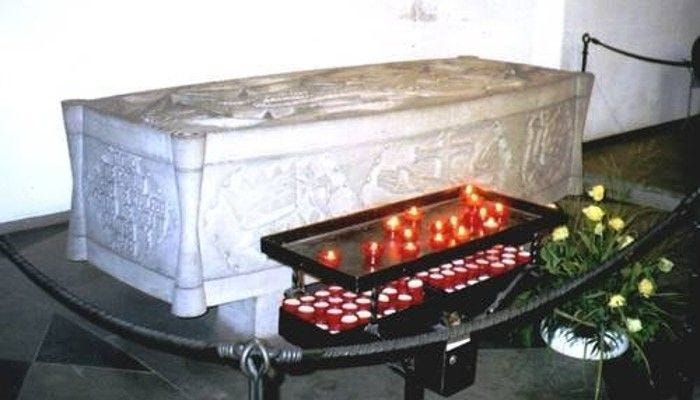
On his sarcophagus there is a short verse in Latin that reads:
Scotia me genuit.
Anglia me suscepit.
Gallia me docuit.
Colonia me tenet.
or
Scotland brought me forth.
England sustained me.
France taught me.
Cologne holds me.
Lord God, source of all wisdom, in Blessed John Duns Scotus you have given us a master of life and an outstanding defender of the faith. Help us to grow in his teaching and to follow the example of his love. We ask this through our Lord Jesus Christ, your Son, who lives and reigns with you and the Holy Spirit, God, for ever and ever. Amen.
A reminder that what we think of as Italy did not unify until 1848. It was before then a collection of individual states under the umbrella of the Holy Roman Empire who jointly, and uneasily, ruled with The Church of Rome. Should the reader be of Italian descent, or have friends who are, you may have noticed even into our time that regional rivalries still exist, those based upon a particular geographic loyalty.
Of the “big four” of Paris, for those keeping count, it is Franciscans 3 - Dominicans 1.
Aquinas’ school of thought was/is known as Thomism. While sounding a bit egocentric, these titles were coined by their student “groupies” and have lasted the centuries.
It is a marvelous irony that The University of Paris, especially in the post-World War II period, has since become the center of European atheism.
It took me five days of scribbling to condense Ralph Waldo Emerson’s philosophy into a sensible form a couple of year ago in these pages. Despite Emerson’s brilliance, doing so gave me a headache. Doing the same with Scotism has probably raised my blood pressure high enough to ring the bell at the carnival.
It is possible that he suffered from seizures as he was reported to shift into a coma-like state from time to time. Some centuries later this led to a tatty rumor that he had been buried alive as he was actually in a coma at the time. Nonsense, of course, as there is considerable difference between a person in a coma and a corpse. However, the conspiracy theory was virulent enough that it was published as fact in Francis Bacon’s History of Life and Death [1638] and echoes of it are still heard in Scotian discussion.