
God’s Razor
William of Ockham [c.1287–1347]

[This is #20 in our series on the 33 Teachers of the Faith.]
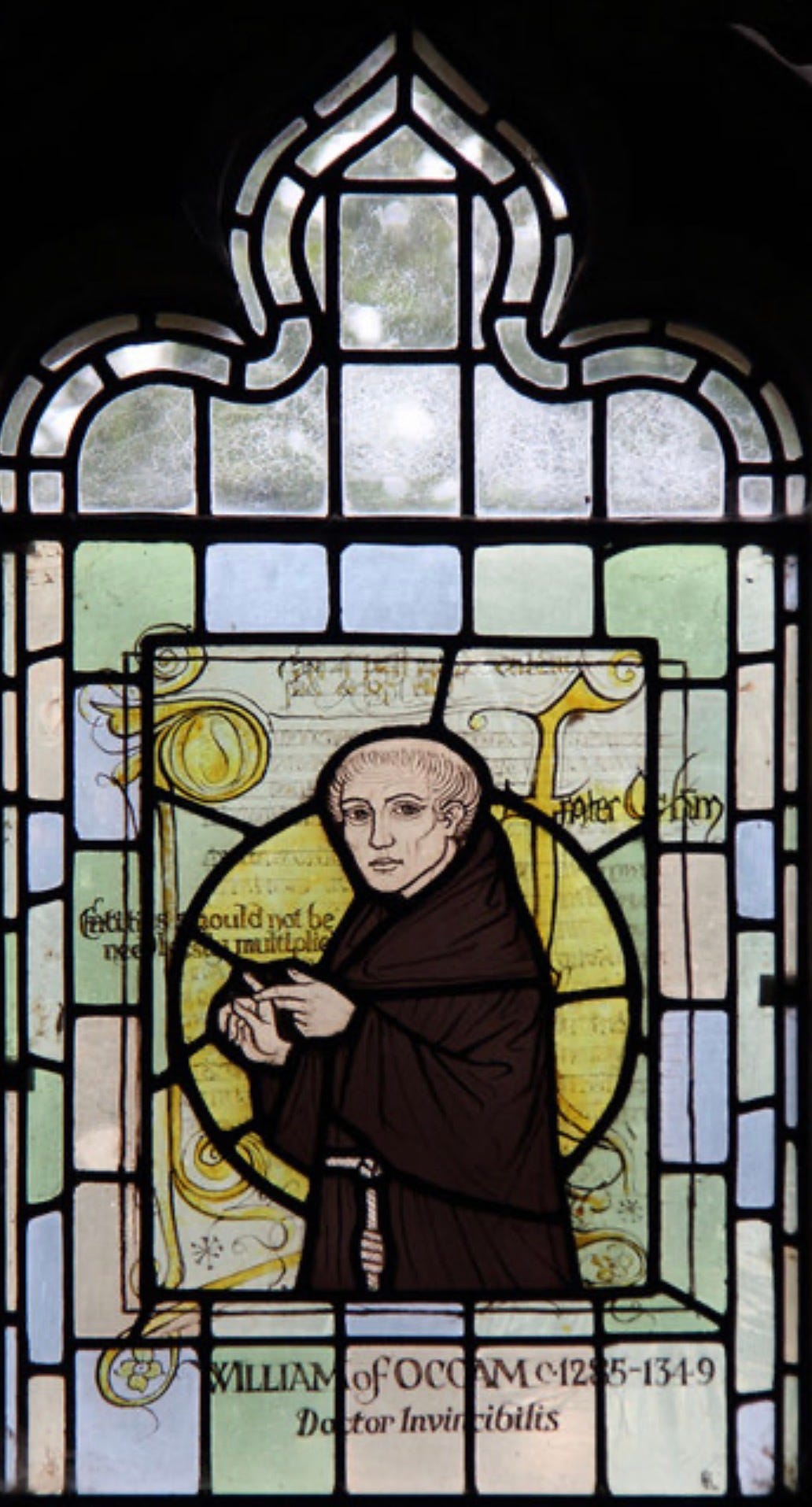
You have heard, and perhaps used, a still common expression of Ockham’s without necessarily knowing its source. Namely, that the “simplest explanation is usually the best.”
William of Ockham, also spelled Occam, was as controversial as he was influential in late Medieval philosophy. A Franciscan friar, priest, theologian, logician, and political scientist, he is best remembered today for “Occam’s Razor,” the principle approach when attempting to understand events and phenomenon.
Living during a turbulent era of papal conflict, plague, and intellectual ferment, Ockham boldly challenged the synthesis of faith and reason that was the conventional wisdom of his age.
Born in the village of Ockham in Surrey, England around 1287, little is known of his early life. As was not uncommon, he likely entered the Franciscan order when very young and pursued studies at Oxford University, though he never completed the full requirements to qualify as a “regent master” due to unspecified “controversies.”
This is why in some quarters of Christianity he bears the honorific Venerabilis Inceptor, or the “venerated beginner.” In others, he is known as Doctor Invincibilis, or “the invincible doctor.”1
In one such controversy in 1323–1324, Ockham was summoned to Avignon, then the site of the papacy, to answer vague, ultimately unresolved charges of heresy related to theological views presented in his Commentary on the Sentences of Peter Lombard. Seemingly one of those personalities who attracts trouble [he’s in good company], while there he became embroiled in the Franciscan poverty dispute2 with John XXII, the Bishop of Rome, and was eventually forced to seek the protection of the Holy Roman Emperor.3
He spent his later years in Munich, writing polemical works against papal power until his death, possibly from the Black Plague, around 1347.
Ockham’s intellectual pursuits were subsequent to the high scholasticism of Thomas Aquinas. As we have noted in A Wandering Coracle, Aquinas harmonized Aristotelian philosophy with Christian theology, imagining a rational universe where concepts like “truth” had universal meaning.
Ockham rejected much of this inherited framework. He championed what is known as nominalism4, arguing that only individual things exist in reality; universal concepts are merely names created by the human mind, abstracted from sensory experience. This was a radical departure from the established metaphysical hierarchy. In particular, Ockham emphasized empirical observation5 as the key to understanding reality.
Entia non sunt multiplicanda praeter necessitatem, or “Entities should not be multiplied beyond necessity.”
Central to Ockham’s method was the principle now known as Occam’s Razor: “Plurality should not be posited without necessity”, which is a very philosophical way of saying, “Keep it simple, stupid.” For Ockham, it is best for one to formulate explanations with as few assumptions as possible.
“It is pointless to do with more what can be done with fewer.”
He applied this to eliminate unnecessary distinctions in physics and theology. For Ockham, the only truly necessary entity is God; everything else is dependent on the Almighty. This parsimony extended to his skepticism about what reason alone could prove, stating that only faith is essential to appreciate life.
[Stop for a moment and appreciate the irony that, in Ockham’s day, The Church attacked him for believing that faith in God as revealed through Jesus Christ was more important than secular academic reason.]
Ockham’s most systematic work was Summa Logicae, or Sum of Logic [1323-1326], which was considered revolutionary. It presented a sophisticated theory for logic as a tool for analyzing language and avoiding fallacies.
His linguistic precision influenced later developments in semantics and the philosophy of language. In natural philosophy, he criticized Aristotelian physics in ways that anticipated aspects of modern quantum physics.
Theologically, Ockham emphasized God’s absolute power (potentia absoluta) and our freedom within it. While accused of fostering skepticism and an over-reliance on faith over reason, Ockham understood his work as a purification from pagan philosophy [i.e. Aristotle], preserving God’s omnipotence.
“The head of Christians does not, as a rule, have power to punish secular wrongs with a capital penalty... The pope therefore, can, as a rule, correct wrongdoers only with a spiritual penalty.”
In Ockham’s later life, he aligned with the “spiritual” Franciscans who were advocating apostolic poverty and defended the idea that the church should emulate Christ’s simplicity as opposed to the Pope’s more “economically accommodating” stance.
In works like the Dialogus and Breviloquium [1335], he argued for limits on papal authority, advocating a separation of spiritual and temporal powers. He contended that the emperor had rights independent of the pope and that heresy charges should be subject to due process. These ideas contributed to the foundation for the separation of church and state, influencing later Reformation and Enlightenment thinkers.
Ockham’s legacy is certainly debated. He is seen these days as a transitional figure who helped dismantle the Medieval synthesis of faith and reason, accelerating the rise of Empiricism6 and the development of the scientific method.
Stephen Hawking, among others, credited Ockham with aiding in the development of quantum mechanics by favoring simpler models. In philosophy, Nominalism prefigured modern philosophical traditions. Politically, his defense of individual rights resonated with subsequent Protestant and secular thinking.
Ockham’s life exemplified intellectual courage amid adversity. Despite being excommunicated for his views on the limits of papal power, he persisted in defending his ideas against powerful opponents.
Ockham’s Razor remains a cornerstone of rational inquiry. In science, law, medicine, and everyday problem-solving, we instinctively prefer simpler explanations. In our age of complex models and information infusion, this call for parsimony is timeless.
Apparently, William of Ockham is still considered rather suspect, as he no longer appears on the calendar of lesser feasts in The Episcopal Church, [although he remains on the calendar of The Church of England]. His former date of April 10 is now held by another. This is rare treatment for one still considered a Teacher of the Faith.7
Anyway, William of Ockham was not just an iconoclast but a systematic thinker whose emphasis on individuals, experience, and necessity reshaped philosophy and theology. He bridged Medieval scholasticism by reminding us that profound insight often comes from cutting away the superfluous to reveal the essential. As we navigate contemporary debates on reality, knowledge, and authority, Ockham’s sharp intellect continues to provoke and illuminate.
O God, whose truth shines forth in the clarity of reason and the humility of faith: grant us, after the example of your servant William of Ockham, to seek wisdom with honesty of mind and simplicity of heart; that, discerning what is necessary from what is superfluous, we may love you above all things, and serve your truth in peace; through Jesus Christ, who is the Way, the Truth, and the Life. Amen.
It appears while Oxford would not award him graduate and post-graduate degrees, he likely completed his education at the Franciscan school in London. He also studied at The University of Paris.
The Franciscans were split on just how poor they should be. The dispute concerned whether or not to be fully mendicant, that is, completely dependent on free will contributions, or to accept a modest royal or papal stipend for their work, along with owning some limited property. This lead to a split in the Society of St. Francis that is still present to this day.
We would remind the reader that 14th century popes commanded their own armies and, um, “security services/secret police.” Unlike bishops in our age, who simply become dyspeptic in your presence, Medieval prelates could be rather harsh and creatively violent. Getting away from an annoyed pope was a rather good idea.
To define it with Ockham’s simplicity, Nominalism is the philosophical position that only individual particular things exist, and that universal concepts are not real entities but merely names we use to group similar things. If this seems dense, and it is, one may thus understand Ockham’s desire for simplicity in observation and theory.
Empirical observation is the acquiring of knowledge through direct sensory experience rather than through pure reasoning, intuition, or speculation alone.
Empiricism is the philosophical view that all knowledge ultimately comes from sensory experience and observation, rather than from innate ideas or pure reason alone.
He has never been considered for canonization nor to be a Doctor of the Church [of Rome] as he was excommunicated for a time; there is some evidence that he may have been reconciled with the church before his death.
Thank you for including this. I always wondered who Occam (Ockham) was. One of the first things they taught us in medical school was Occam’s Razor, or otherwise stated “When you hear hoof beats, think of horses, not zebras”. This works very well unless you encounter a zebra.