
Direct Illuminations
A Purposeful Walk with Theodore Roosevelt, William James, and Tom Bombadil

Note: This post is too lengthy for an email and will need to be read in its entirety from the website, as found at A Wandering Coracle. Feel free to take your time with it.
“Mystical truths are not to be gained by intellectual processes; they are direct illuminations.”1
Consider this a theology of recalculation.
Well, let’s call it the first step in its creation.
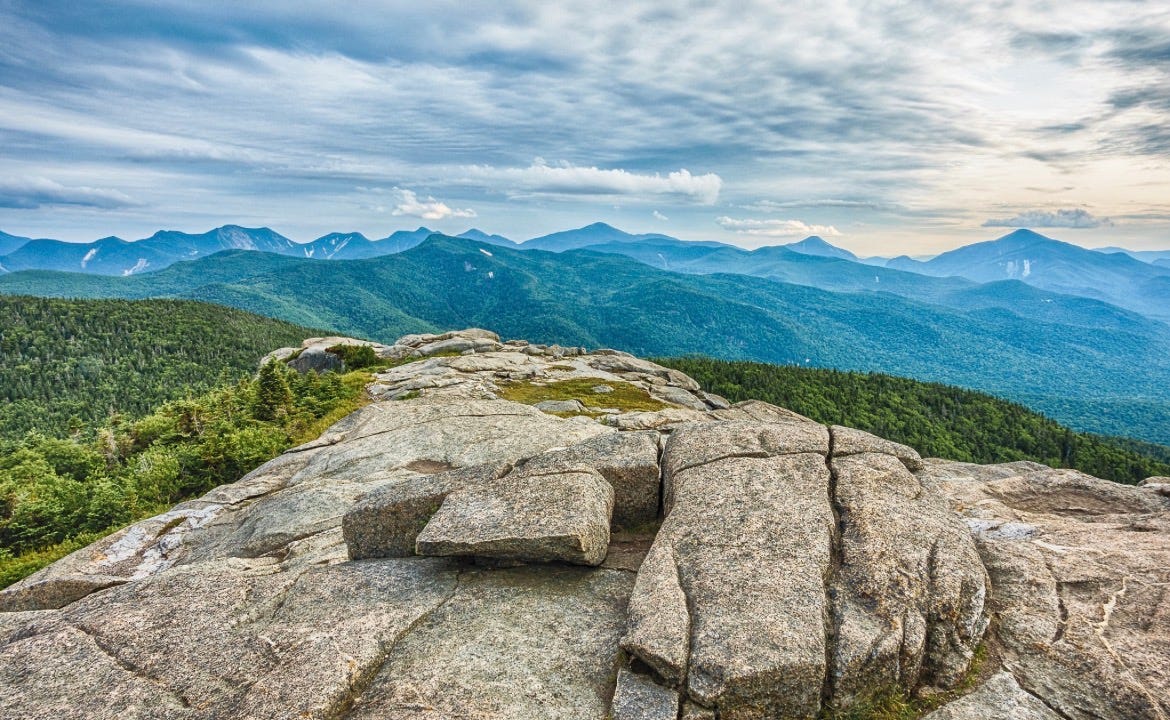
I’d like to say that this is simply an objective appreciation of a place of spiritual and historical importance, but I cannot. There was something else that took me to the Adirondack Mountains, to the highest peak in New York, taking a five hour drive from my home on a mid-May morning, when the weather was so brisk that it was snowing when I arrived at the hotel parking lot in Lake Placid at 2 o’clock in the afternoon.
At the time, I didn’t realize what it was. I must thank Tom Bombadil and many others for helping with that.
He Was Called “The First Hiker of the United States”
In early September of 1901, for the third time in 36 years, there had been an assassination attempt on the President of the United States. On two of those occasions, with Abraham Lincoln and James Garfield, the assassins were successful.
Fortunately, it appeared that President William McKinley, although grievously wounded, was recovering. So confident were his doctors that his cabinet members were able to relax and his vice president, Theodore Roosevelt, was free to vacation with his family.
As the Roosevelts were a rambunctious bunch, Theodore’s notion of relaxation was to make an arduous climb to Mount Marcy, the highest peak in New York, one that he had heard described in spiritually lofty terms by a former college professor of his.
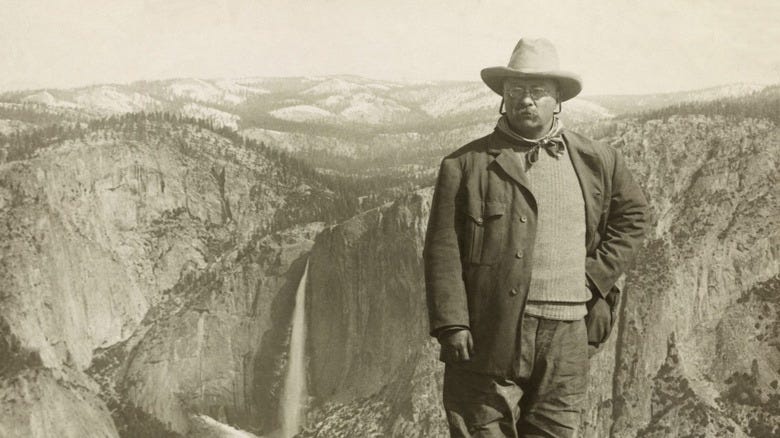
Of the Adirondack Mountains, and the American wilderness in general, Roosevelt would write, “There can be nothing in the world more beautiful…and our people should see to it that they are preserved…forever.”2
After setting up an overnight camp, when sundown was approaching, Roosevelt, a veteran of long camping trips in the Dakotas, Rockies, and Cuba, noticed something far, far down the trail: a series of lights, certainly from a cluster of torches, gradually working their way in the darkness up to his campsite.
Roosevelt sensed that McKinley was dying, perhaps already dead, and that the midnight hikers were guides coming to deliver the news and get him to where he would be sworn in as the President of the United States. Thus, Mount Marcy hosted one of the memorable moments in American history.3
Some Geology and History
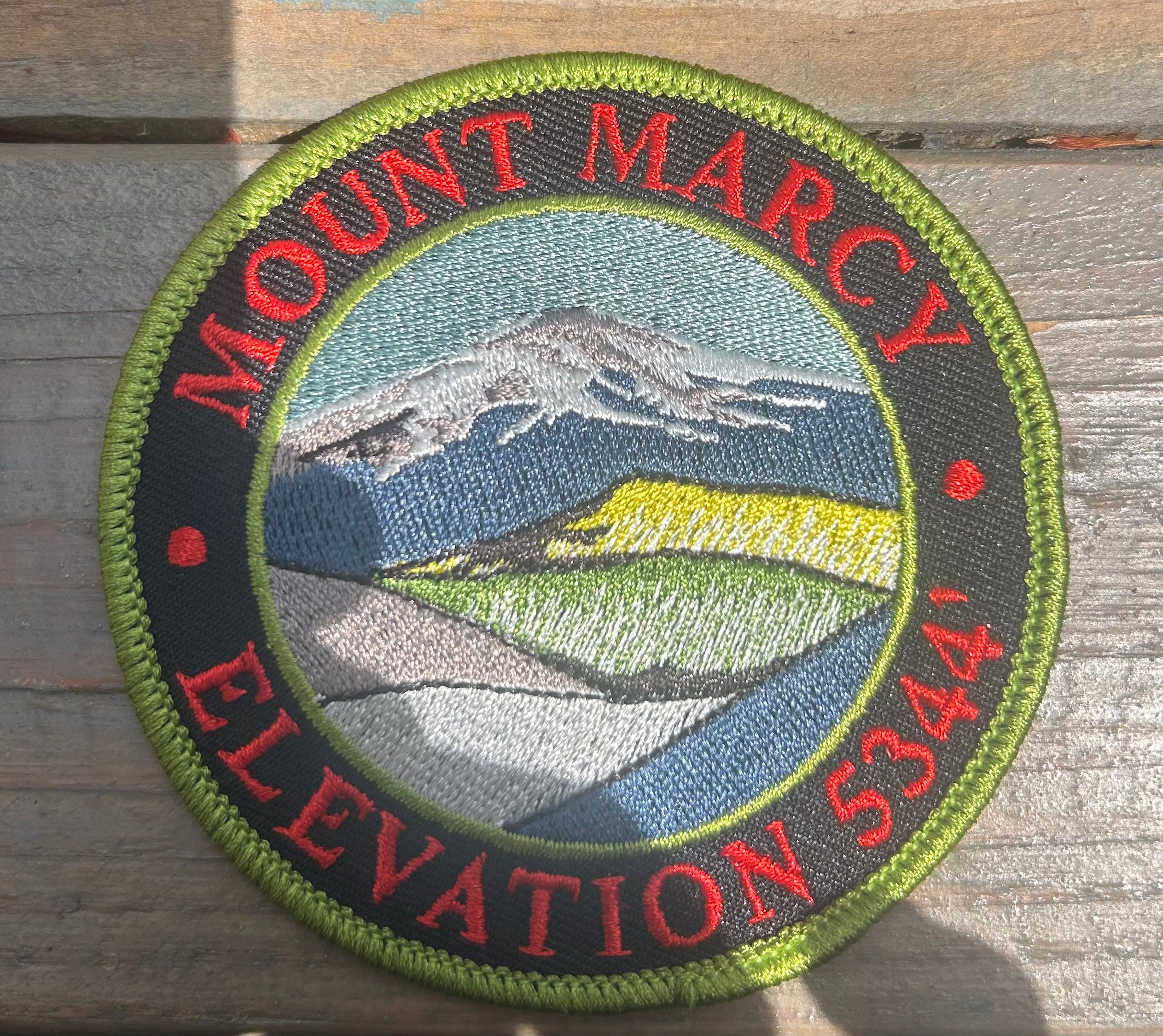
As noted, Mount Marcy is the highest peak in New York State. At 5,344 feet, it is in the heart of the High Peaks region where over forty accessible peaks may be found.
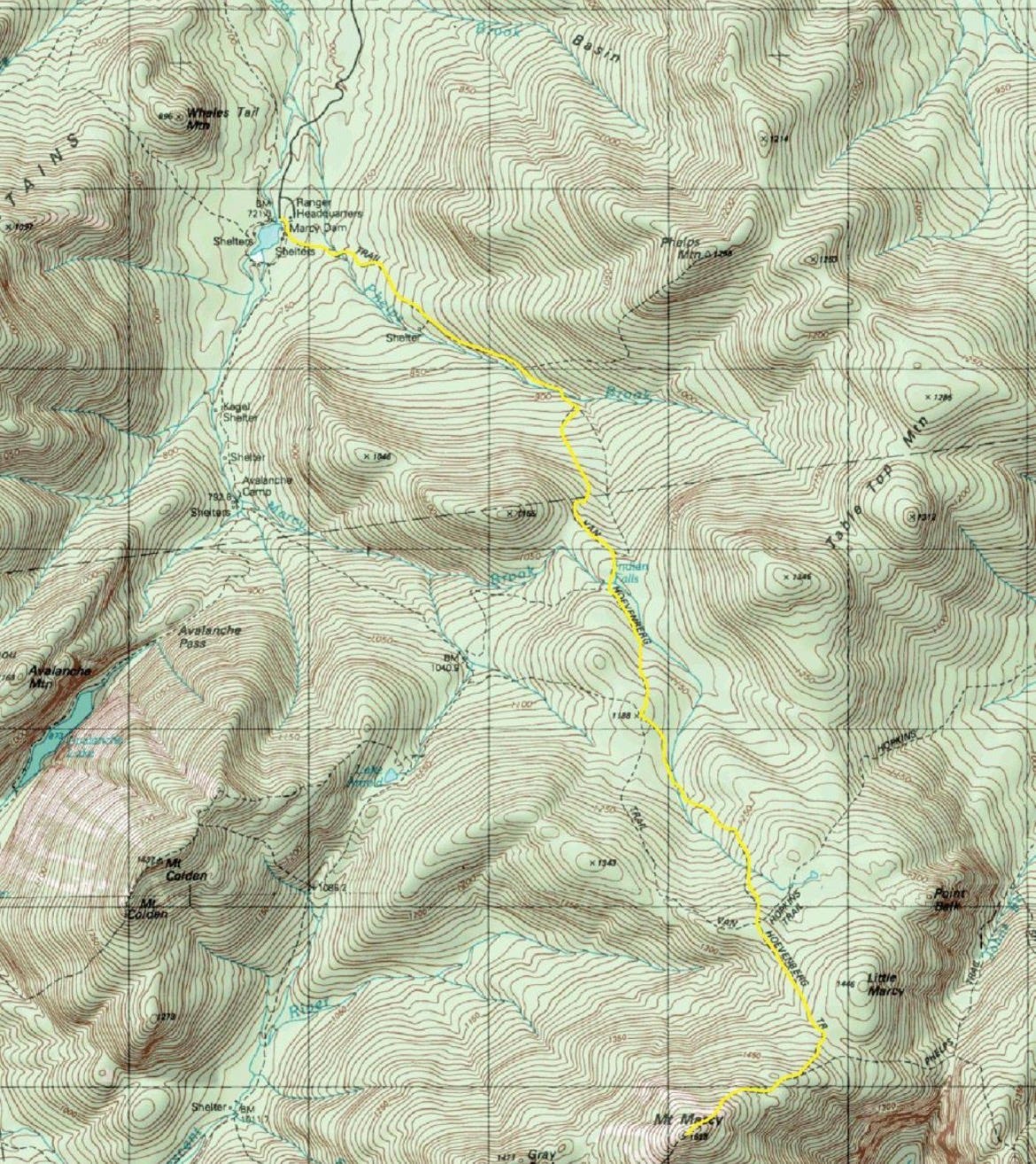
It began to form 1.1 billion years ago during what geologists label the “Grenville Orogeny,” the continent vs. continent collision that created the Adirondack mountain range and much of the distinctive terrain of the northeastern United States. While I’m not trained in such things, I am assured by those who are that the view from the top reveals exposed rocky outcrops, alpine vegetation, and geologic processes that offer a window into Earth’s history as it was reshaped by glacial ice.
The area was prime hunting grounds for the Algonquin and Iroquois tribes, and later for the settlers. In 1836, when the state of New York was getting serious about its real estate, the mountain range was formally surveyed, with the first recorded ascent made the next year by Ebenezer Emmons, the state geologist. As William Learned Marcy was the governor, the peak was named for him.
[Actually, I prefer Tahawas, or “cloud-splitter,” which was the Seneca name for the mountain as it’s evocative of the peak’s striking views.]
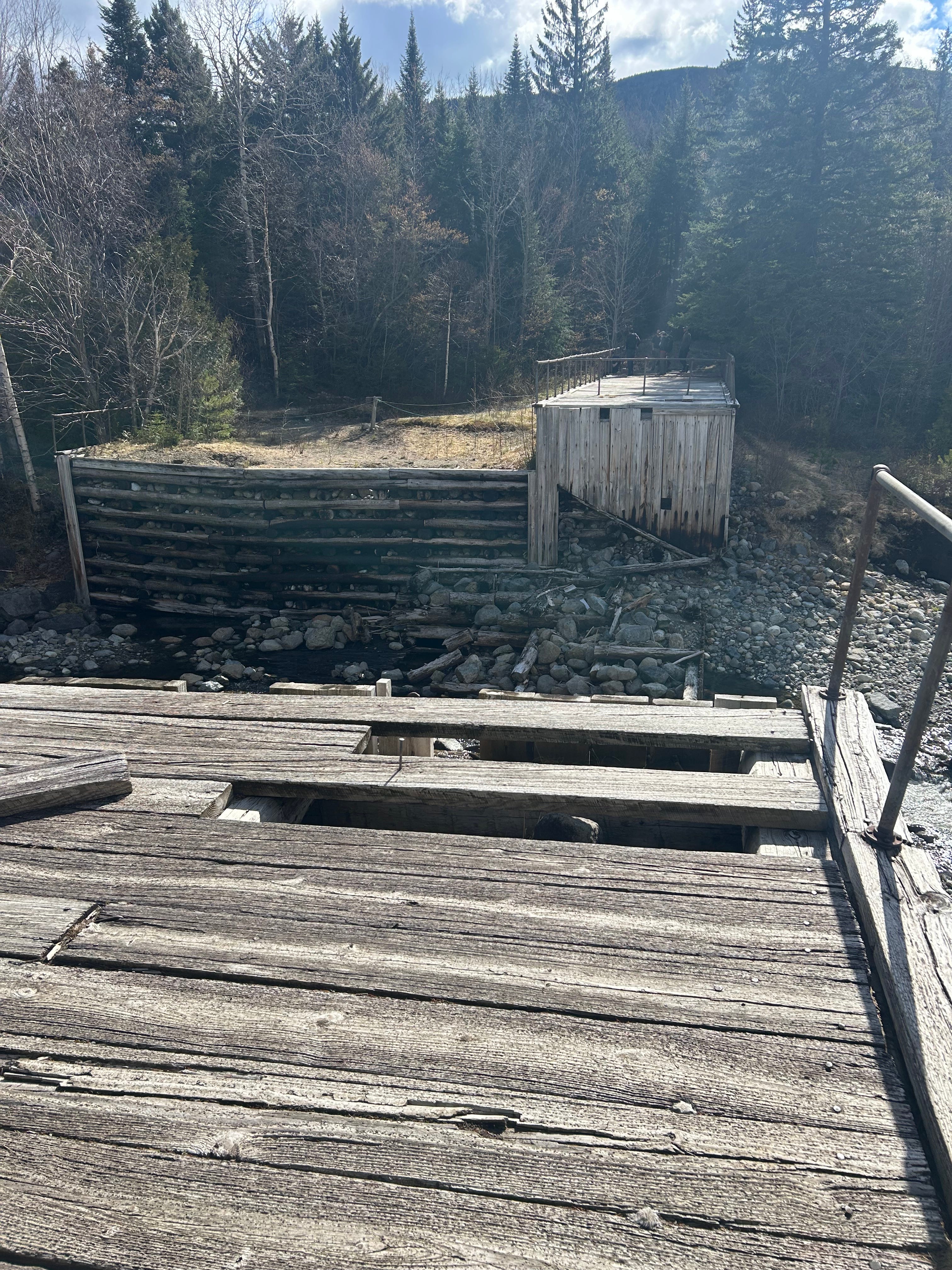
With formal surveys complete, Mount Marcy and its environs became a logging camp with a dam built about half-way up the current trail. It has since been left to decay and, while it no longer serves as a dam, its ruins aside misty falls are a pleasant rest stop for those ascending or descending.
Realizing the natural beauty and geological importance of this area, New York declared it a state protectorate as Adirondack Park in 1894. Since 1922, it has been in the care of the Adirondack Mountain Club as they now maintain the trails and pursue its conservation.
Which is one of the reasons that Roosevelt, the father of our national parks system and champion of unspoiled American wilderness, sought to climb its peak.
The Spiritual Hiker
“Certain aspects of nature seem to have a peculiar power of awakening such mystical moods. Most of the striking cases which I have collected have occurred out of doors.”4
Three years before Roosevelt’s memorable ascent, William James, the vice president’s former professor who taught Religion at Harvard Divinity School, Psychology at Harvard Medical School, and Philosophy at Harvard University5, and an original voice in American spirituality, hiked the same trail to the same spot, to view the mountains and their grandeur and marvel at the sense of vastness and beauty that was before him.
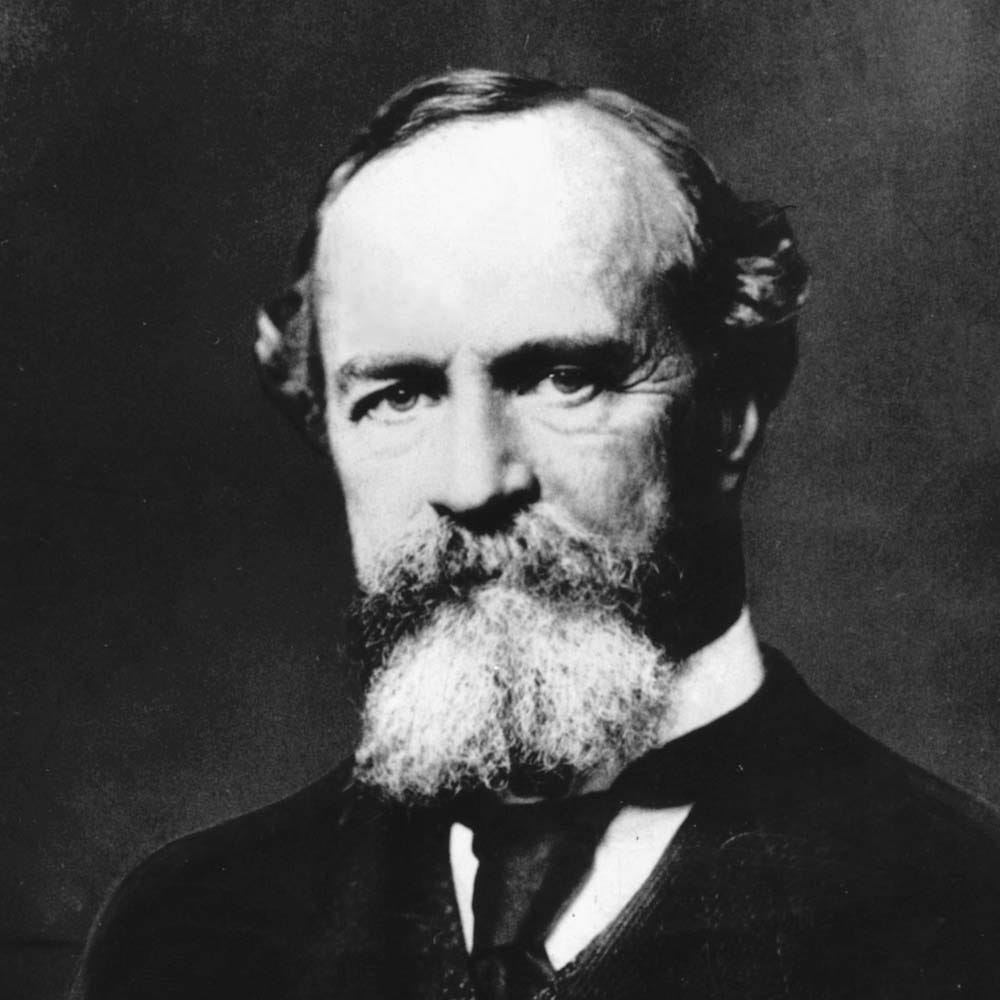
James, of whom we have written in A Wandering Coracle, walked this exact trail in the summer of 1898, mentally composing a series of lectures he was to give at the University of Edinburgh later that year; lectures that would later be edited and published as The Varieties of Religious Experience [1902], the first comprehensive, American, and truly modern examination of ascetical theology; what’s now more often called “mysticism.”
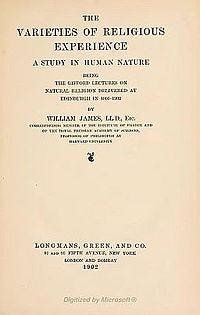
While pausing overnight, he had an intense spiritual experience, realized amid the quiet, raw nature of the Adirondacks.
As he wrote to his wife just two days after his moment of revelation:
The guide had got a magnificent provision of firewood, the sky swept itself clear of every trace of cloud or vapor, the wind entirely ceased, so that the fire-smoke rose straight up to heaven. The temperature was perfect either inside or outside the cabin, the moon rose and hung above the scene before midnight, leaving only a few of the larger stars visible, and I got into a state of spiritual alertness of the most vital description. The influences of Nature, the wholesomeness of the people around me…all fermented within me till it became a regular Walpurgis Nacht. I spent a good deal of it in the woods; where the streaming moonlight lit up things in a magical checkered play, and it seemed as if the Gods of all the nature-mythologies were holding an indescribable meeting in my breast with the moral Gods of the inner life. . . . The intense significance of some sort, of the whole scene, if one could only tell the significance; the intense inhuman remoteness of its inner life, and yet the intense appeal of it; its everlasting freshness and its immemorial antiquity and decay; its utter Americanism and every sort of patriotic suggestiveness, and you and my relation to you part and parcel of it all, and beaten up with it, so that memory and sensation all whirled inexplicably together; it was indeed worth coming for, and worth repeating….It was one of the happiest lonesome nights of my existence, and I understand now what a poet is.6
The Varieties of Religious Experience is so seminal, and still on seminary/divinity school auxiliary reading lists, that I wanted to experience this place of revelation, to follow James’ trail, see the peaks and gorge where he found his illumination, and get some appreciation, or even inspiration, from the trek.
Recalculating
“Above all, do not lose your desire to walk: every day I walk myself into a state of well-being and walk away from every illness; I have walked myself into my best thoughts and I know of no thought so burdensome that one cannot walk away from it.” – Kierkegaard7
This wasn’t solely an academic quest. I suppose I should acknowledge that I’m going through a change not just in the outward circumstances of my life, with the realities of age and retirement, but with something in my spiritual life of which I am just becoming aware.
For the past decade I have been visiting the holy sites of Christianity and other religious traditions. Hindu monasteries in India, Muslim mosques in Oman and the UAE, Orthodox synagogues in the US, Buddhist monasteries in Sri Lanka and Singapore, and Anglican churches in the Pacific Rim, among others.
In each I speak with the worshippers and ask about what they seek and what they find. For some, it is simply the ratification of family tradition; for others it is the fulfillment of a spiritual quest, however modest. Those who had the most satisfying religious experience were those who had to strive for…something…to achieve even a slightly elevated sense of awareness.
I used to have that feeling on Sunday mornings. However, life in the pew is not the same as life behind the altar and pulpit. I am left woefully uninspired by contemporary liturgy, which is often maladroit, the sermons, which can descend into blunt political harangues, the hymns that are played at the joyless tempo of a dirge, and the muted participation of the parishioners who seem embarrassed to pray and sing in public.
When I return home after the Sunday liturgy, it is with a sense of emptiness.
Which is why I am here, on this trail worn by James and Roosevelt and, as with myself, many, many people of lesser significance in the establishment of the American character, to attend to the place where James met his moment of mystical turning.
I only wish I had done so thirty/forty years earlier, as the backpack’s heft and my wonky knee are reminding me that I will enter my eighth decade this year.
However, in many ways I’m in better hiking shape than I was in those days, and the mild discomfort begins to lessen and then ceases to be a reality as I put the miles behind me.
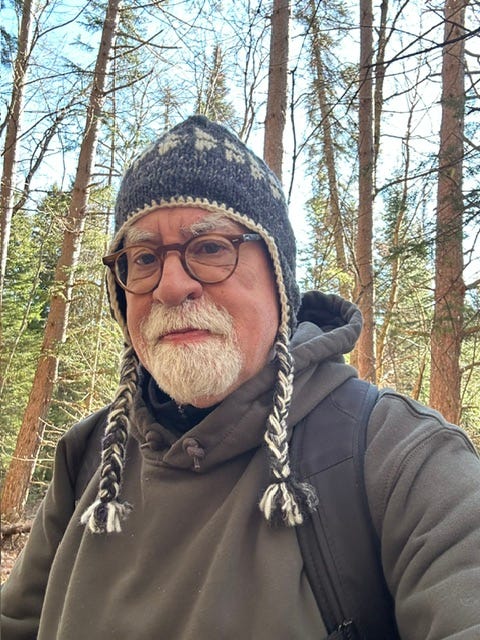
Also, I am of a spiritual maturity that begins to lend a shape to life, its colors and flavors, that I did not sense when I was younger. This is no doubt due to my awareness of mortality. Last year’s near death, to paraphrase Dr. Samuel Johnson, concentrated my mind wonderfully.8 I wish to experience Being and Otherness more deeply, and a rote formula of Protestantism no longer serves that purpose.
But on this morning, I am in the presence of a profound natural beauty, one that our history runs through like a river and infuses our national character, from the baldly political to the gloriously mystic, with a compelling intonation.


As I was all alone on the trail, it being 7am and 29° when even the wildlife was sensibly dormant, I decided to sing a hearty mountain song as a cadence. Unfortunately, I don’t know any mountain songs, hearty or otherwise, so I thought the Toby Keith tune I heard on the car radio on the way to the trailhead fit the circumstances.9
I was reminded of how Ralph Waldo Emerson, the first real philosopher of “American-ness,” would be described by his contemporaries as “The Philosopher of the Internal Gyroscope.”
While physical gyroscopes are less common in navigation these days, clearly my internal spiritual GPS was recalculating. I was in a place and mood for re-appraisal.10
William James identified a similar spiritual malaise in himself and his patients [recall, he was a psychologist before there was such a thing], which is one of things that lead him up the mountain.
So, why not start, or re-calculate, where he did? Clearly, as with Roosevelt and James, it is a place of change. A strenuous climb to New York’s highest peak, weaving through the wild nature of the Adirondacks, abiding in the absolute quiet of an assiduous forest.
I felt myself one with the grass, the trees, birds, insects, everything in Nature. I exulted in the mere fact of existence, of being a part of it all....11
In Varieties, James writes that the “uneasiness of the sick soul” is a potential gateway to a richer life. He viewed it as the starting point for “vital religion,” as unbalance can transform faith into salvation and deeper meaning.
While this would have been a rather grand expectation, given that I was interested in seeing if I could actually survive to the peak, I was open to the sheer deliberation of the venture.
“We ought to take outdoor walks, to refresh and raise our spirits by deep breathing in the open air.”12
I was going simply to put one foot in front of the other, not proceeding at any deliberate speed, until I was where I wished to be. Since the peak required a little scrambling on all fours at the top, perhaps I should say one hand and foot in front of the other.
I had been advised to get to the Adirondack Loj [pronounced “lodge”; I have no idea why it is spelled that way] trailhead by dawn in order to get a parking space. Given this was a Tuesday in the first half of May, with the air temperature in Lake Placid a few degrees below freezing, with Lord knows what temperature awaiting me on the mountain, I had a more leisurely morning planned.
So, I left the hotel for the 20-minute drive, five miles of which was just the side road approaching the Loj’s parking lot, almost ninety minutes after sunrise, figuring I would be the only person present.
There were already eighteen cars in the lot by the time I arrived.
A few belonged to the staff managing the Loj, with the rest those of hikers far heartier than I was that morning.
Despite that, on my ascent I neither met nor laid eyes on any other hikers at all until I reached Marcy Dam just under 2 ½ miles up.
The silence, as noted, was impressive. Outside of the birdsong that increased as the sun rose, it was as quiet a setting as I think I’ve experienced in the Northeastern woodland. It was not hard to imagine what it would have been like for Roosevelt and James in those earlier days, especially as I was following the same trail.
Back in the 1990’s, when I hiked in multiple stages the Appalachian Trail from the top of Massachusetts [part of which was conveniently placed just behind the school where I was working; the side trail was below my office window] through the short, fifty-mile section in Connecticut, I recall never quite being free of traffic noise, however slight.
Tom
On this trail, there was nothing but the resonance of wakening nature, with the alluring burble of running water from the falls just below the dam. So immersed was I in the winsome sounds that I was startled when a human voice greeted me.
“Hello. Lovely morning, isn’t it?”
My greeter was dressed in well-worn hiking clothes, none of which were made of synthetics, nor the type purchased at REI or L.L. Bean. He was ruddy and dark, wearing a leather hat that was as worn as was his face. While I was carrying a collapsible hiking pole [just one; I’m not entirely geriatric], he had a proper walking stick that appeared hand carved.
“I thought it would be colder,” he noted.
I replied about feeling rather well-heated by that point in the climb.
“Just wait. This is the easy part.” His smile revealed a missing upper front tooth.
We chatted some. He had that look that I’ve since come to recognize, so I asked if he were a forty-sixer13 and he nodded.
“I’m kinda a four hundred and sixtier. I’ve been hiking these peaks for over twenty years now. This one is my favorite. I’m here at least twice a season.”
We spoke of the discipline and ambition required to climb all forty-six Adirondack peaks. I admitted I had little of either.
He observed, “Oh, I was like that once upon a time. Then you just start walking. If you get in the mountains, they kinda call to you, and you just go.”
[My interior monologue: Have I just crossed paths with some sort of mountain sadhu, dervish, or sage? Or am I suffering from a lack of oxygen?]
As we spoke of this and that, the conversation took a left turn into mushrooms, as I was curious if he knew of any forgeable varieties along the trail as I was interested in trying to harvest some wild spawn.
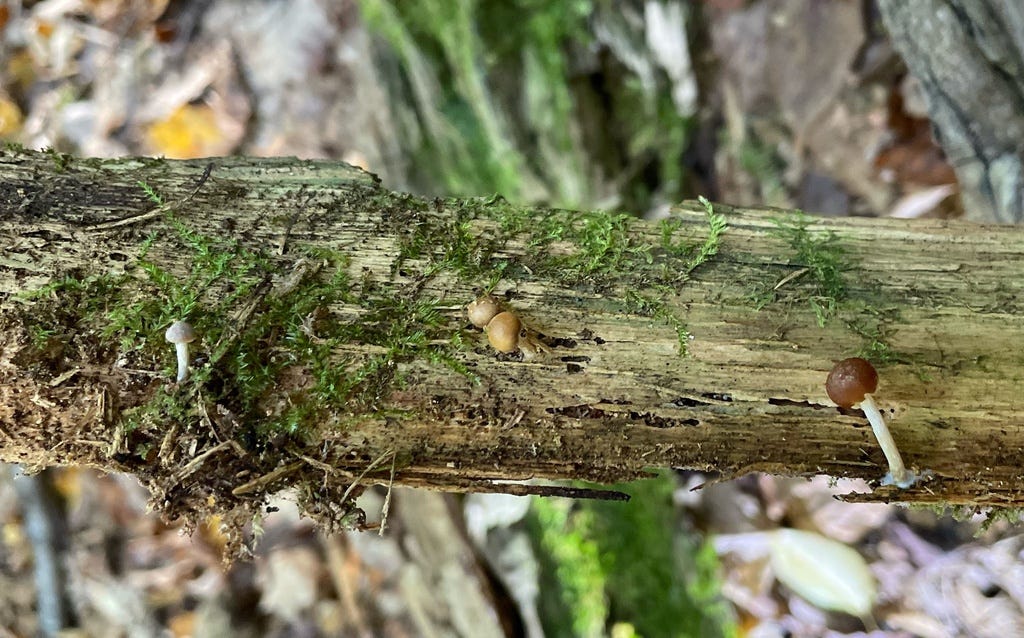
“Oh, yeah. You gotta be careful, though. Hard to tell the difference between good things and bad things. You know what’s nice about deep woods hiking?” He mildly swung his rustic walking stick in a circle around us.
“When you’re in the woods, you can always find something you can use. Like this stick. Or something you can eat, like mushrooms. It may not seem like it sometimes, but there are useful things everywhere out here.”
He leaned forward a bit, “Even things you didn’t think you needed.”
Having seemingly satisfied himself with that metaphysical minute, he bid farewell and began descending to the Loj and I continued ascending to the peak. I realized after we had parted that, while we hadn’t introduced ourselves by name, I imagined him to be Tom Bombadil.

Hikes, Walks, and the Spiritual Life
The idea of a mountain or other prominent geological feature calling to one is common in world religion. As all religions began in a simplicity resonant with nature, the practice of “spiritual walking” is a shared theme.
William James was not doing anything terribly original. Purposeful walks and hikes have long served as expressions of transformation. Indigenous cultures worldwide have incorporated walking into vision quests and other rites of passage, permitting the land itself to become a spiritual tutor.
Sit as little as possible; do not believe any idea that was not born in the open air and of free movement in which the muscles do not also revel… Sitting still… is the real sin against the Holy Ghost.”14
As noted in the gift of my hiking hat, Buddhist monks practice kinhin, or walking meditation, the act of moving slowly between periods of seated silence. Muslims realize the perambulation to Mecca as one of their pillars of faith. Early Judaism celebrated Shalosh Regalim, the "Three Pilgrimage Festivals" of Passover, Shavuot, and Sukkot, when travel to the Temple in Jerusalem was expected.
Beginning in the Middle Ages and increasingly popular even in our century, Christians have walked the Camino de Santiago across Spain to reach the shrine of St. James, seeking healing, reconciliation, and a deeper faith.
Even labyrinths, the antique coiled paths found in cathedrals and sacred sites, represent a form of spiritual walking. Traditionally, a labyrinth has only one route to the center and back, symbolizing the journey toward a definition of truth.
With the reference to Enoch in the Older Testament,15 Christianity’s understanding that we are on a shared journey with God became a scriptural leitmotif. From that starting point, all deliberate journeys in the Older and Newer Testament became spiritually purposeful, from the escape of the Israelites to Jesus’ peripatetic earthly ministry, then to the roads to Emmaus and Damascus. It is through the act of physical travel that we begin to discern our true companion.
Philosophers and writers have also celebrated this practice. Henry David Thoreau found what he regarded as a form of divinity during his daily rambles through the woods near Walden Pond, writing that walking allowed him to settle his accounts with the world.16
[Also, he walked to his mother’s house once a week so that she might do his laundry.]
Scientific studies increasingly validate these spiritual traditions. When practiced mindfully, rhythmic motion synchronizes with breath, helping to regulate the nervous system and shift brainwave patterns towards a calmer alpha state.
Research into the Japanese practice of Shinrin-yoku, or “forest bathing,” finds that time spent walking among trees lowers cortisol levels and boosts healing cells. Ecopsychology [yes, there is such a thing] suggests that reconnecting with natural environments through walking fulfills an innate human need for belonging, combating the loneliness that is too common these days.
But to our purpose, from the Israelites’ Wilderness to the cathartic moment of realization by William James, spiritual walking opens doors to transcendent experiences.
Our presence within the rhythm of nature can dissolve the boundaries between self, world, and kingdom. Certainly, creativity flows more freely, and many walkers report sensations such as deep gratitude, reconciliation with reality, and a sense of interpenetration with nature, all leading to a mystical awareness.
Of the forms of spiritual walking that are organic to religious experience, there is mindful walking that emphasizes sensory awareness; contemplative walking that involves holding a moment of scripture or intention in the mind while moving, with some walkers repeating a prayer, either whole or in phrases, with each step.
As with the Camino hike and other spiritual trails around the world, there is pilgrimage walking, usually taking place over days or weeks, which is experienced as a transformative journey.
My Vajrayana Buddhist acquaintance maintains his practice in a Manhattan temple, where his order understands that even urban walking can hold power, with the city streets as living mandalas where every person, storefront, or even early urban shadows, carry meaning.
Denouement
So, there is a lot of history and science that is supporting my endeavor, although after a rest at the dam and my conversation with Tom Bombadil, I would have welcomed some physical support as well. As Tom noted, the trail does get progressively more challenging after that waypoint.
By this time, I was joined by more hikers who were younger, fitter, and faster, if not as likely to rise as early on frigid mornings. I give them room to pass, with one young man of thirty or so with a GoPro camera strapped to his chest confessing to me as he passed, “Man, this trail kicked my ass.”
I could only nod with elderly sagacity, attempting to disguise the fact that I was still recovering my breath from my last surge and resisting the temptation to respond with, “Wait until you’re my age.” I only wished I was resting on a Gandolph-style rustic walking stick like Tom Bombadil’s instead of an aluminum, shock-supported, cork-handled, collapsable model from a sporting goods store.
It’s hard to have gravitas when using contemporary equipment.
There is a particular sense of accomplishment when the peak comes into view, although I did sit for a bit as it first seemed about as easy to climb as the summit of K2, and after a brief rest seemed more manageable and less distant and daunting.


That, too, is part of the spiritual walking experience. Not only does the hiker become a suscept to his or her own rhythm, but as one’s attention is immediate and specific to the situation, common concerns and worries about yet-to-form events dissipate.
There is a change in perspective as one must concentrate on taking careful steps, gauging fatigue, checking for a sensible pace. The immediacy of the walk, be it a hike, or a pilgrimage, or a pleasant stroll, renders the past into something inert and distant and the future open in its absoluteness.
So, the burden that I’ve been feeling, the sense of age, last year’s near-death, the lack of spiritual inspiration in common worship, my own diminished role in the institution in which I served for so long and so well, all faded. The very real burden of climbing up and, with my wonky knee, the even greater burden of climbing down, became my chief concerns.
Hours and miles later, when I saw the roof of Adirondack Loj through the trees, the immediate burdens faded along with the more existential. The walk was complete.
That was a pleasant re-ordering, along with the realization, now that I’m divorced from the routines and labor of parish service, that worship in a building is a simple conduit, and not the cauldron of definition that we sometimes wish it could be.
There is a greater cathedral built of intention, will, and reunion as an integral part of nature, a sensation that renders a shifting professional role and stunted liturgies into lesser, manageable parts within a greater construction of meaningfulness.
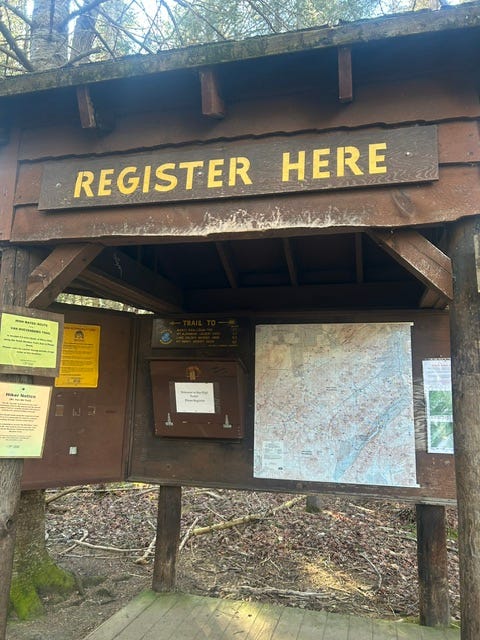
When I stopped at the trailhead kiosk to place a check mark next to my name in the register, indicating that I had returned successfully and was not in need of the services of the local mountain rescue community, I once again nodded to Tom Bombadil, who was seated with Tolkien-esque authority on a nearby log, pouring what I hoped was mud from his boots.
“Hey, you’re right,” I called. “You can always find something in the woods you can use.”
“Told ya”, offering his porous smile. “Everything except a podiatrist,” he said, while massaging his foot.
Benediction
O God, whose glory is revealed in the beauty of the earth and whose presence is known in the silence of the forests: Grant us sure footing on the trail, strength for the climb, wisdom in our decisions, and gratitude for the wonders that surround us; and bring us safely to our journey’s end, through Jesus Christ our Lord. Amen.
from Varieties of Religious Experience (1901) by William James
from Roosevelt’s Outdoor Pastimes of an American Hunter
One may follow the well-signed, historic 40-mile stagecoach trail taken by Roosevelt from the trailhead, at what was described as breakneck speed, to the train station that would convey him to Buffalo. It is known as the Roosevelt-Marcy Trail, or Route 28N in New York.
from Varieties
He was a bit of an overachiever.
from James’ letter to his wife, Alice. Clearly, he was a literate, even lyrical person, as should come as no surprise as his brother, Henry, was the best-selling author of the period and his sister, Alice, was likewise an author who hosted a popular literary salon.
from a letter written by Soren Kiekegaard to his niece, Henriette [1847]
The original quotation is “Depend upon it, sir, when a man knows he is to be hanged in a fortnight, it concentrates his mind wonderfully.” - from James Boswell’s The Life of Samuel Johnson, LL.D. (1791)
I used to be hell on wheels/Back when I was a younger man./Now my body says, “You can’t do this, boy,”/But my pride says, “Oh, yes you can.”
With a tip of the hat to long-time reader Kim Wicks Mairano, who used the metaphor of a recalculating GPS in a sermon of her’s one Sunday in Pentecost a few years ago. Yes, I always remember the good sermons.
from Varieties
from Seneca’s De Tranquillitate Animi [On Tranquility of Mind]
A forty-sixer is a member of the Adirondack Forty-Sixers, a non-profit hiking club in northern New York State that recognizes people who have climbed all 46 of the traditionally recognized High Peaks of the Adirondack Mountains.
from Friedrich Nietzsche’s Twilight of the Idols (Götzen-Dämmerung)
“22 Enoch walked with God after the birth of Methuselah for three hundred years, and had other sons and daughters. 23 Thus all the days of Enoch were three hundred and sixty-five years. 24 Enoch walked with God; then he was no more, because God took him.” [Genesis 5:22-24]
from Henry David Thoreau’s Walden; or, Life in the Woods
Thank you, Rob for another walk with you. I shared in the beauty of the outdoors and the new concerns caused by wonky knees and other “as you mature” issues. I also shared in the “where do I belong” in a church. As with many, my story is long and complicated. But God really is good and faithful and (eventually) sees us through.
Rather than "well there's half an hour I'll never get back"...that was an awesome read. Kim Wicks Mairano's spiritual GPS (mine is screaming "turn around as soon as possible")...Tom Bombadil, one of my favorite Tolkien characters...the word "cathartic" reminding me (nerd alarm going off) that yesterday I learned that "pure in heart" in Greek is hoi katharoi te kardia, katharos being a richer word than simply pure or clean. Also, in my world, a hike means a 15 minute walk with the dog, so good on you.